Showing posts with label maegaki. Show all posts

Sunday, July 18, 2010

Maegaki: The Top 10 Most Influential Manga-ka

In the past week, Oricon Entertainment Inc., well-known for their weekly rankings, released the results of a poll that recently asked for Japan's ten most influential mangaka artists that had changed the history of manga. The three-day poll asked 841 men and women all over Japan between the ages of 10 and 40, and the results were posted on their website. (H/T: Silicon Era)

1. Osamu Tezuka (Astro Boy, Black Jack)
2. Akira Toriyama (Dragon Ball, Dr. Slump)
3. "Fujiko F. Fujio" (a.k.a. Hiroshi Fujimoto and Motou Abiko - Doraemon)
4. Eiichiro Oda (One Piece)
5. Takehiko Inoue (Slam Dunk, Vagabond)
6. Shigeru Mizuki (GeGeGe no Kitaro)
7. Fujio Akatsuka (Tensai Bakabon)
8. Machiko Hasegawa (Sazae-san)
9. Hayao Miyazaki (Nausicaä of the Valley of the Wind)
10 (tie). Osamu Akimoto (Kochira Katsushika-ku Kameari Kôen Mae Hashutsujo)
10 (tie). Naoki Urasawa (Monster, 20th Century Boys)

Not a bad selection, but I have a few things to say about this ranking in terms of its operation:
  1. The sample size seems to be rather small. Asking only 841 people for this survey seems to sell the influence of manga immensely short. I have a hard time believing that Oricon could cut the pool to such a small cross-section; that's 0.00067% of Japan's population!
  2. The sample size seems rather restricted to the younger generation. If you assume the oldest to be in their 40's, then we're likely talking about manga fans who are more biased towards titles written after 1975. I'm not saying that there were no influences after 1975, but it does seem to tell us that Oricon doesn't consider the older generation to have a say in the matter.
  3. There is an obvious bias towards shônen manga. Yes, we foreigners may be a little more biased in our approach of manga, but the closest you get to shôjo manga is Tezuka's Takarazuka-influenced Ribon no Kishi, and the only female mangaka listed (Hasegawa) didn't quite change the style of manga as much as she proved a woman could compete in the manga industry. More importantly, considering that four of the authors have written specifically for Shônen Jump, I tend to believe that more of the interviewed subjects read that anthology more than others.
Perhaps the last entry is how the poll is to be read: this isn't as much a poll about influence on style as it is about influence on manga's history. Of course, influence on style tends to alter the direction of future manga artists. Still, I feel that some important names are missing from the chart:
  • Rumiko Takahashi. How is it that arguably the biggest female shônen-manga author got left off this list? How is it that the creator of Ranma 1/2, Inuyasha, and Maison Ikkoku was dissed? Perhaps this image of Takahashi as a dominant domestic mangaka is an illusion; after all, in 2006's Japan Media Arts Festival, Urusei Yatsura was ranked 31st in the 100 Best Manga ranking, behind the likes of Hunter X Hunter and Ushio and Tora.
  • Monkey Punch / Takao Saito. Considering that both Golgo 13 and Lupin the 3rd are two action icons that still exist in print and film to this very day, it's a wonder if these two don't cancel each other out in terms of influence. Then again, maybe we're looking at a niche market, when manga itself is such a broad industry.
  • Riyoko Ikeda. Considering just how influential the entire Year 24 Flower Group was on shôjo manga, Ikeda deserves to be a representative for the group's power. While some may argue Naoko Takeuchi is more deserving of entry, The Rose of Versailles could be argued as the real precursor to both the starry-eyed style of shôjo manga and the gender confusion we see in many manga over the past fifteen years.
  • Leiji Matsumoto. A giant in science-fiction manga doesn't even get a nod for his work in Space Battleship Yamato, Galaxy Express 999, and Captain Harlock? Again, we're probably looking more at his immense influence in anime, but Matsumoto is also quite the manga historian, having composed a referential book that chronicles manga from the 1920s to the late 1950s with Hidaka Bin.
  • [Other possible entries: Katsuhiro Ôtomo (Akira), Go Nagai (Devilman), Seiji Matsuyama (just kidding).]
If the rankings were to be rewritten?

1. Osamu Tezuka
2. "Fujiko F. Fujio" (a.k.a. Hiroshi Fujimoto and Motou Abiko)
3. Akira Toriyama
4. Rumiko Takahashi
5. Shigeru Mizuki
6. Machiko Hasegawa
7. Takehiko Inoue
8. Riyoko Ikeda
9. Leiji Matsumoto
10. Hayao Miyazaki
(Akatsuka, Ôtomo, Saito, Nagai, and Monkey Punch would be knocking on the door, in that order.)

Am I biased? Certainly. I still think that Kochira Katsushika-ku Kameari Kôen Mae Hashutsujo is horribly overrated and that One Piece is too recent to be ranked. Am I Japanese? Certainly not. My opinion is obviously corrupted by my ethnicity and my Western influences.

But I'm still crying foul about this survey.

Tuesday, June 1, 2010

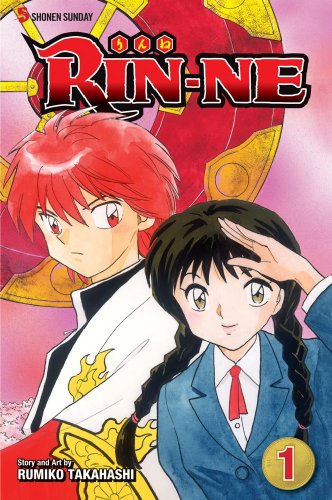
Maegaki: RIN-NE

[The Japanese term "maegaki" (前書き) refers to the preface of a book, literally meaning "before writing". Maegaki marks AniMaybe's first trek into print-media reviews and will cover everything written down on flat surfaces that cover anime and/or manga.]

Disclaimer: I'm a total Rumiko Takahashi fanboy. Card-carrying member since '92.

There has been no attempt for me to hide my love for all things Rumic in this world (including the adjective itself). So far, my Twitter avatars have both been Takahashi-based characters (Godai from Maison Ikkoku, Daisuke from Ranma 1/2). I actually loved the Mermaid Saga stories, and One-Pound Gospel is perhaps one of the most understated of her works. InuYasha threw me for a loop, but I found myself appreciating its animated run in Japan and consistently watched it while I was there.

It was unfortunate to hear of InuYasha's ending, since that moment signaled the first time where I questioned if it truly was the last we'd hear of Takahashi. Her works were so extensive, almost spanning decades at a time, and she is easily one of the wealthiest mangaka in Japan. What other mountains were left to climb? However, we also forget the fact that Takahashi should still have lots of fuel left in her tank. She is still only 52; she started Urusei Yatsura when she was 21 in 1978.

When Takahashi brought out her latest creation, Kyôkai no Rinne ("Rinne of the Boundary", titled RIN-NE in the U.S. release), the fans likely had to take a step back to breathe. Much like she did with Urusei Yatsura (oni), the Mermaid Saga series (ningyô), and InuYasha (yasha), Takahashi is turning to the mystical traditions of Japan, although she has opted to focus on the shinigami figure that has been the mainstay in stories such as Soul Eater, Death Note, Yû Yû Hakusho, and (most prominently) Bleach. While there is some crossover with the "obakemono" traditions of Japan, this story focuses more on the relatively comical passing of spirits to the underworld, led by the fiery-haired Rokudô, a high-school student born from the intersection of human and shinigami bloodlines.

His accidental meeting with Sakura—a girl who has the power to see spiritual beings thanks to her own temporary "spiriting away"—during one of his exorcisms is not as accidental as it may appear. While the other students can't see him when he has on a haori coat from the Underworld, Sakura can, and she gets wrapped up in each of his attempts to send the school's spirits to the other side. Additionally, being a human shinigami has its limits both spiritually and financially, and the purchase of such goods to free these ghosts and rescue Sakura are not cheap to a dirt-poor student such as Rokudô. Throw in a cat-demon who is similar to Shippo from InuYasha (but less annoying than he ever was) and Rokudô's cougar age-defying shinigami grandmother, and the episodic comedy actually has a place to go.

All in all, that's the relief that comes to mind after reading RIN-NE. With the drama of InuYasha gone, it's nice to have Takahashi returning to her roots. While she can tug on a heart-string every now and then, Takahashi's expertise is in comedy, and it's good that she's returning to what's made her so successful. The artwork remains simple, and the angle of each character's profile rarely changes from the fixed side-view, but that allows Takahashi to remain focused on her stories and characters.

There may be arguments that Takahashi and Shônen Sunday are attempting to copy the success Tite Kubo and Shônen Jump achieved with Bleach, but I'm not so sure that Takahashi even wishes to fully copy herself. While Kubo has opted for focus on a plethora of angst-ridden characters and endless fighting sequences, Takahashi has actually pulled away from tension by focusing on cooperative efforts between Sakura and Rokudô. While there is little doubt Takahashi will not stray from her past devices (foes becoming friendly rivals in the end), Sakura and Rokudô are not your typical Rumic couple—no arguments, no relationship pressures, and no difficult emotions cloud their association in the beginning, and that could be a refreshing change of pace that makes this lighthearted comedy about the Afterworld even lighter.

It's hard to say how the new shift to digital media and the weakening of the manga industry will affect Takahashi's works, Viz is already banking on a mix of the two, providing online translations of chapters the week they are released in Japan and eventual transitions of the volumes to paper print. While opinions on the Shônen Sunday page appear mixed, I feel confident that RIN-NE will do better than expected due to the Takahashi name alone and its appeal to fans of works in the past.

RIN-NE. Vol. 1 on sale through Viz Media. 200 pages, $9.99.